Unusia Holds 35th Congress Discussion to Discuss Shifting Authority and Leadership Dynamics at NU

Humas Unusia
Content Writer
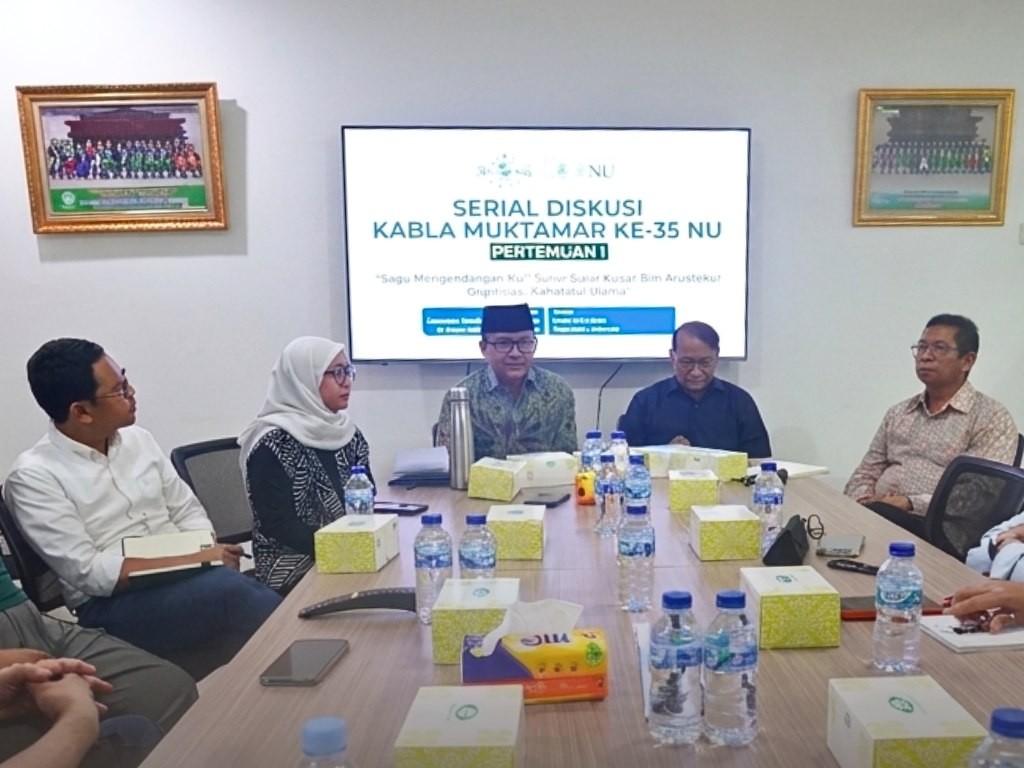
Jakarta – Ahead of the 35th Nahdlatul Ulama (NU) Congress in Tambak Beras, Jombang, the Nahdlatul Ulama University of Indonesia (Unusia) held a 35th Congress Discussion titled "Who Controls NU? Tracing the Power Lines and Organizational Architecture of Nahdlatul Ulama" on Saturday (July 18, 2026). This forum provided a space for reflection to discuss the changing landscape of authority, the distribution of power, and the dynamics of leadership within NU in the face of social and political change.
In the discussion, scholar Fachry Ali assessed that the centers of influence within NU no longer reside in a single figure or institution. He argued that the organization's direction is now influenced by many actors working simultaneously, resulting in increasingly dynamic leadership patterns.
"The controllers of NU are becoming increasingly anonymous. It's difficult to pinpoint who truly determines the direction of the organization. There are many centers of influence working simultaneously," said Fachry Ali.
He added that this situation serves as an important reminder for NU to continue maintaining its independence as a civil society organization. According to him, the ability to maintain autonomy and distance itself from various forms of state intervention is one of the important lessons to be learned from NU's history.
Meanwhile, Ahmad Suaedy, Dean of the Faculty of Islam Nusantara (FIN) at Unusia, believes that changes in authority within NU are inextricably linked to developments in the digital world. He believes that digital transformation has changed the way religious authority is formed and distributed, so that it no longer relies entirely on formal organizational structures.
"The digital world has changed the way authority is produced and distributed. Authority is no longer solely in the hands of formal elites, but is also influenced by more fluid and open digital spaces," explained Ahmad Suaedy.
He believes that digitalization has opened up broader participation for Nahdliyin members, but on the other hand, it has also created various new centers of legitimacy, posing challenges for the organization in maintaining its authority and governance.
Acting Rector of Unusia, Dr. Syahrizal Syarif, also reviewed the dynamics of the relationship between the Rais Aam (Islamic Leader) and the Chairperson of the Executive Board (Tanfidziyah), which has continued to evolve since NU returned to the 1926 Khittah (Church Principles). He explained that the relationship between religious authority and administrative leadership has always undergone adjustments in line with the organization's development.
"The relationship between the Rais Aam and the Chairperson of the Executive Board (Tanfidziyah) has never been static. There have been periods when the sharia authority was dominant, but there have also been periods when the executive board has become more prominent. These dynamics are part of the organization's adaptation process to changing times," said Syahrizal Syarif.
The discussion, moderated by Any Rufaedah, was the first of five series of discussions at the 35th NU Congress, organized by the Unusia Academic Syndicate. This forum will take place every Saturday until August 15, 2026, as a space for dialogue and reflection in the lead-up to the 35th NU Congress.
Discussion Series Coordinator, Fariz Alnizar, stated that the series of activities aims to enrich understanding of various strategic issues facing NU.
"Through this discussion series, Unusia strives to provide a more in-depth understanding of various strategic issues facing NU, ranging from the distribution of power, the welfare of Nahdliyin (NU members), the transformation of Islamic boarding schools (pesantren), NU's relationship with the state, and projections of NU's organizational form in the next century," Fariz explained.
Through this forum, Unusia affirms its commitment as an academic space that provides critical and constructive discussions on various strategic issues of Islam, nationality, and the future of Nahdlatul Ulama in the lead-up to the 35th Congress.