Unusia Holds 35th Congress Kabla Discussion Series to Discuss Governance Reform and Strategies for Citizen Welfare

Humas Unusia
Content Writer
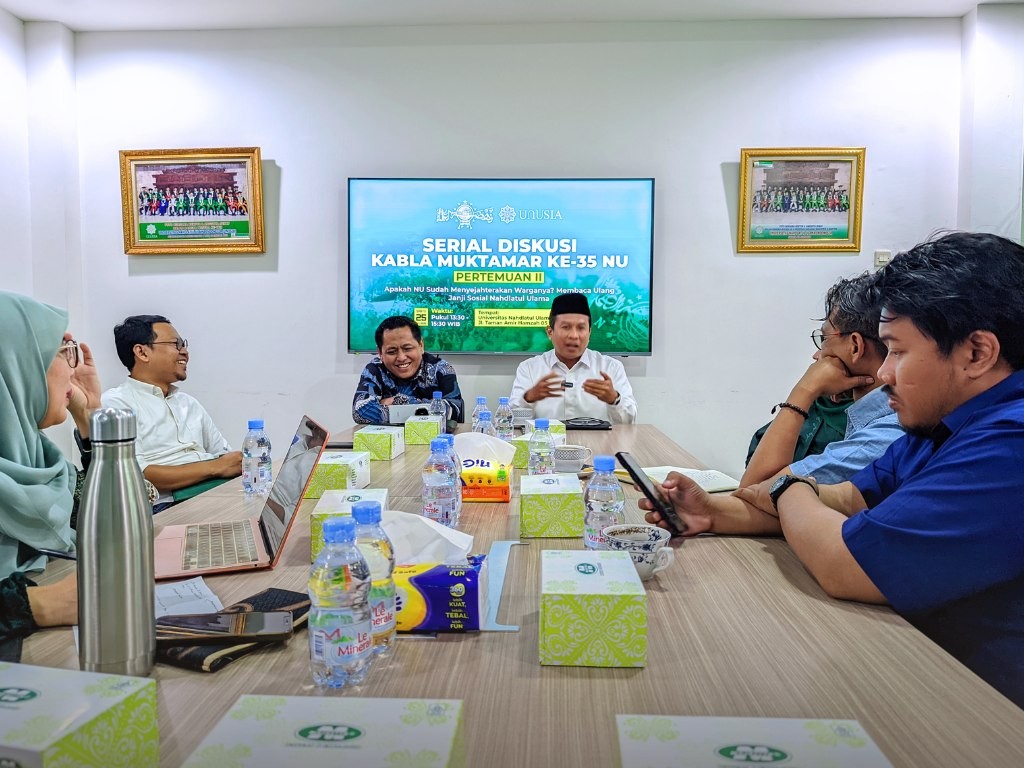
Jakarta – Nahdlatul Ulama Indonesia University (Unusia) held another Kabla Discussion Series for the 35th Nahdlatul Ulama (NU) Congress at the Unusia Campus in Jakarta on Saturday (July 25th). Following the first meeting, which discussed the shift in authority and internal dynamics within NU, the second meeting raised the theme "Has NU Prospered Its Citizens? Rereading Nahdlatul Ulama's Social Promise?" as a forum for academic discussion to examine organizational governance, NU's relationship with the state, and strategies for strengthening NU's role in realizing citizen welfare in the lead-up to the 35th NU Congress.
The forum featured academic and energy policy practitioner Muhammad Khalid Syeirazi and Unusia Faculty of Law lecturer Ahsanul Minan as speakers. The discussion also included Unusia lecturer Idris Masudi's perspective on strengthening the organization's theological foundation in responding to public policy dynamics.
In his presentation, Muhammad Khalid Syeirazi assessed that NU possesses significant social capital, necessitating the maintenance of its independence as a civil society organization. He stated that collaboration with the government remains crucial, but must be conducted through a critical engagement approach to ensure the organization's ability to maintain its oversight function over various public policies.
He also emphasized the importance of strengthening human resource capacity through education so that NU can produce professionals to manage various strategic sectors according to their areas of expertise.
Meanwhile, Ahsanul Minan, a lecturer at the Faculty of Law at Unusia, assessed that NU's main challenge in realizing citizen welfare lies in the lack of alignment between its institutional design and the organization's mission. He explained that this goal is actually stated in the Articles of Association and Bylaws (AD/ART), but remains normative because it lacks measurable achievement indicators.
He believes this situation has resulted in suboptimal work program development and implementation. Furthermore, the organizational structure, which still emphasizes representation rather than program implementation, has resulted in professionalism not being a primary consideration in the formation of the leadership.
"Therefore, the organizational design (of NU) and its established mission are not well-connected, including the mission of improving the welfare of its citizens," said Minan.
On the same occasion, Unusia lecturer Idris Masudi highlighted the importance of renewing the theological perspective of Ahlussunnah wal Jamaah (Aswaja) in national life. He argued that Aswaja values need to be continuously developed as an ethical foundation that encourages NU to carry out its social control function and critique public policies that conflict with the public interest.
Through the Kabla Discussion Series for the 35th NU Congress, Unusia is committed to providing a space for academic dialogue that encourages the emergence of strategic ideas and recommendations for strengthening the Nahdlatul Ulama organization. The various views expressed in this forum are expected to contribute intellectually to the 35th NU Congress and strengthen the organization's role in addressing societal challenges.