Research Team Explores the Legacy of Sundanese Ulama's Pegon Book at the Nurul Fata Islamic Boarding School in Sukabumi

Humas Unusia
Content Writer
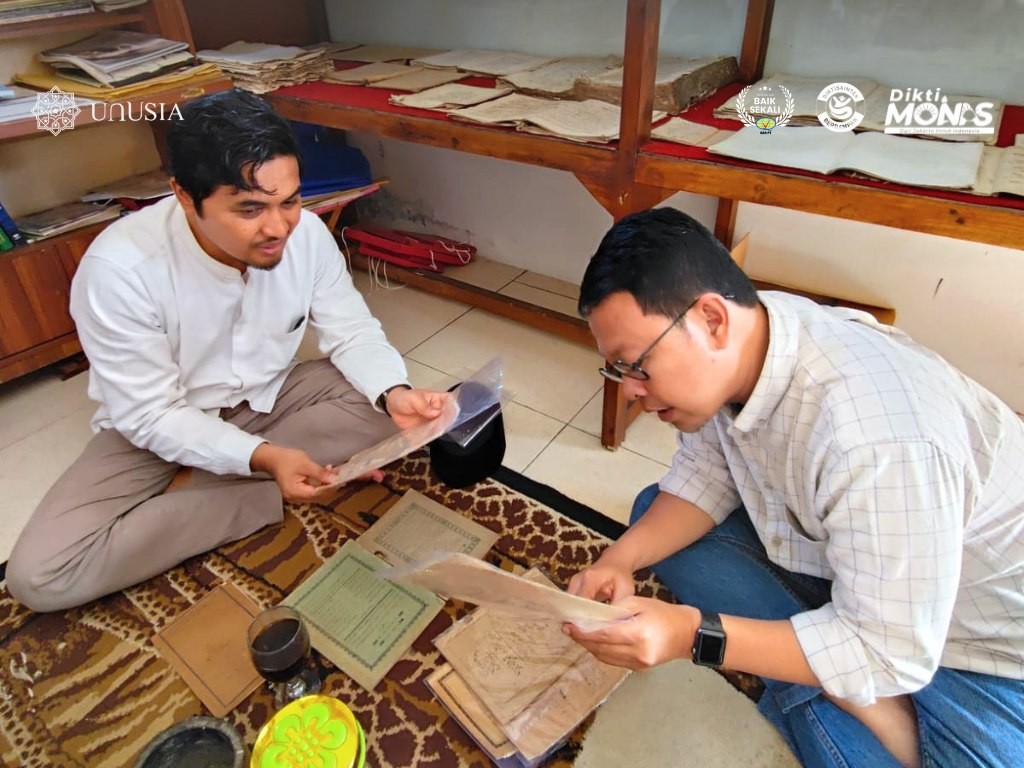
Sukabumi – The research team for the project "Jawi-Pegon Cosmopolis: Tracing the Path of the Yellow Book as a Distinct Identity of Nusantara Islamic Civilization in the International Arena" conducted field research at the Nurul Fataa Islamic Boarding School, Cikondang, Sukabumi Regency, West Java, from June 25 to June 27, 2026. This activity is part of the research implementation supported by the MORA The AIR Fund program, a collaboration between the Ministry of Religious Affairs of the Republic of Indonesia and the Education Fund Management Institute (LPDP).
The research team, consisting of Fariz Alnizar, A. Ginanjar Syaban, and Alanuari, conducted direct investigations of the collection of books and manuscripts inherited from Sundanese scholars that have been preserved within the pesantren environment. The purpose of this field research is to enrich data regarding the Path of the Yellow Book, particularly the Islamic intellectual tradition in the Sundanese region that developed through the use of Pegon script during the Dutch colonial period, especially in the early 20th century.
During the activities, the research team had the opportunity to meet and discuss with KH. Enden Ahmad Muhibbuddin, the caretaker of Nurul Fataa Islamic Boarding School and the owner and custodian of the Sundanese scholars' manuscript collection. This meeting became an important moment to document the history of the collection, trace the origins of the books, and obtain information regarding the network of scholarly transmission connecting Sundanese scholars with other pesantren in Java and Islamic study centers in the Middle East.
In this research, the team successfully identified several works of Sundanese scholars printed using Pegon script. The collection demonstrates that the tradition of Islamic literacy in the Sundanese region has developed in a very dynamic manner. These books not only serve as learning materials within the pesantren but also act as a means of disseminating Islamic knowledge to the community through the use of the Sundanese language written in Pegon script. These findings illustrate how local scholars adapted language and script to make Islamic knowledge more accessible to the local population.
In addition to identifying these works, the team also documented various bibliographic information, including book titles, authors' names, printing details, publication years, physical conditions of the collections, and characteristics of Pegon script usage. This data will form an important part of the annotated catalog of the Path of the Yellow Book, one of the primary outputs of the research. Furthermore,